The Summer the Honey Turned Red
A true Gatlinburg story about the summer drought when bees turned candy scraps into red honey.
Gatlinburg Roots
3/18/2026
Gatlinburg Roots: The Summer the Honey Turned Red
He didn’t go looking for trouble. He said it plain: “I can’t tempt it.” He wasn’t about to make a bee sting him—not because he was afraid, but because he didn’t want to hurt his bees. But if one caught him by accident, he’d just grin and say, “That’ll take care of my arthritis.”
And somehow, it did.
Arthur J. Ogle kept his bees up on the hill above Gatlinburg, as many as nine hives at a time. He set an old bench out under the chestnut trees he planted himself after the originals were gone. Every afternoon, he’d sit there quiet, watching his bees. They’d land on his shoulders, crawl across his arms, and most days they never bothered him at all.
He loved them, and they seemed to know it.
Then came the summer nobody forgot.
It was hot—so hot the flowers dried up across the mountains. The mountains were parched, and the nectar was gone. The bees couldn’t find what they needed in the hills anymore.
So they flew down into town.
Right below the Methodist Church sat the Ole Smoky Candy Kitchen, where bright red candied apples were made and sold along the street. Not far away, right in the middle of town, was Aunt Mahalia’s Candies—another place full of sugar, apples, and sweets.
When the tourists were done, what didn’t get eaten got thrown away. The trash bins behind those shops were full of the sticky, red remains of the day’s confections.
The bees found it.
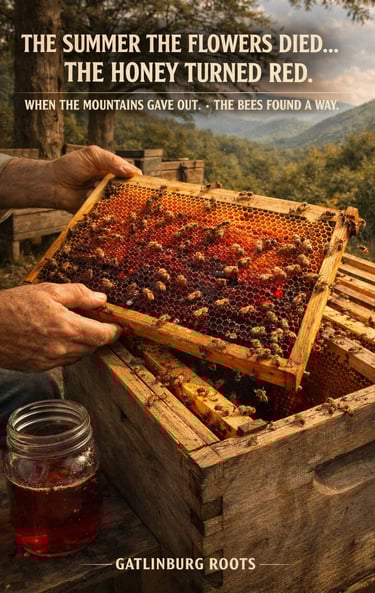
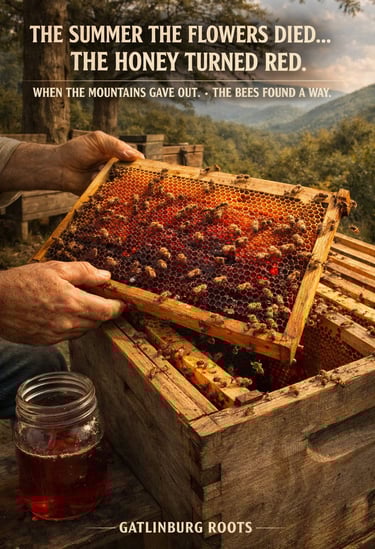
They worked the candy apples in the trash, carried that bright red sugar back up the mountain, and packed it deep into the comb.
When the frames were pulled that year, the honey didn’t look right. Inside the honeycomb itself, the cells weren’t filled with the usual golden amber. They were filled with deep red honey—dark crimson in some places, lighter in others, with strange pale streaks running through it.
It wasn’t golden. It was red.
It was the prettiest honey you ever saw.
But it wasn’t mountain honey—not the way it was meant to be. That honey was taken from the hives, processed, and poured into jars just like any other. And while real mountain honey will keep for decades—jars of it still sitting good even fifty or sixty years later—this batch didn’t hold. Because of all that processed sugar from town, it started breaking down. It crystallized and went off in a way real honey never does.
Still, for one season, it told the truth.
About a year when the mountains gave out…
…and the bees found a way.
Story shared with Gatlinburg Roots by Doris Ogle Marr, recalling her father, Arthur J. Ogle.